
by Alanna Mitchell, Science and Medical Journalist
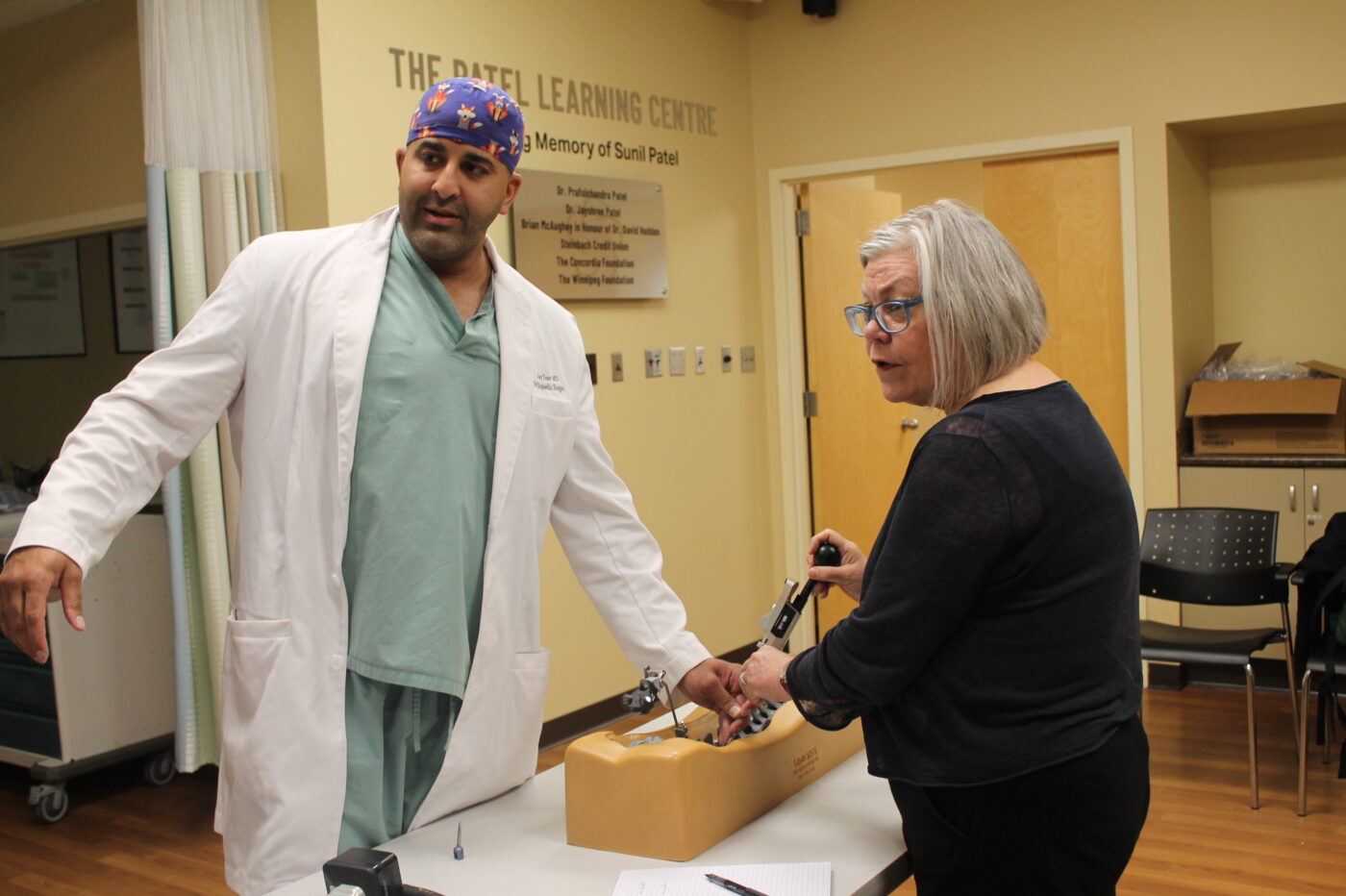
Jay Toor did not always plan to become a spine surgeon. While training in orthopaedic surgery in Toronto, his life changed after a terrible accident in his family. His grandfather, who was strong and active even in his 80s, fell down the stairs and suffered a severe spinal cord injury. Despite emergency surgery, he passed away.
That heartbreaking moment shaped Dr. Toor’s future. He decided to focus his career on spine surgery, believing that the ability to move your hands and legs is one of life’s most precious gifts.
After finishing most of his specialty training — and even earning a business degree to better understand how hospitals work — he was called to help improve spine care in Manitoba. In 2023, he moved to Winnipeg, where many patients were waiting years for surgery. Dr. Toor believed new minimally invasive technology could change that. He worked tirelessly, sharing his ideas with health leaders and demonstrating how better tools could help patients recover faster while also saving the health-care system money.
Today, he performs advanced spine surgeries at Concordia Hospital and helps train surgeons from around the world. He says the teamwork and patient-focused spirit he found in Winnipeg inspire him every day. For Dr. Toor, the goal is simple but powerful: help people return to the activities they love and give them the freedom to live life without pain.

Dr. Jay Toor is one of the surgeons helping bring new spine surgery techniques to patients in Manitoba. He works at Concordia Hospital and the Health Sciences Centre, where he cares for people with serious back and spine problems.
Dr. Toor is excited about the new technology because it allows surgeons to do safer, more precise operations with smaller cuts. This helps patients feel less pain and recover faster so they can return to their normal lives sooner.
He also plays an important role in teaching other surgeons. Doctors from across Canada and around the world come to Winnipeg to learn these advanced skills, helping spread better spine care to even more people.
He arrived in Winnipeg in 2023 and started running spreadsheets.
At once, he realized that if the province invested in new, minimally invasive technology for spine surgeries, it could reduce waiting times and dramatically lower costs. He started cold-calling Uzoma Asagwara, the Minister of Health, asking for a meeting. He arrived at her office with sheafs of paper, showing that the province could buy the new equipment, shorten waiting times and save millions of dollars a year. A couple of weeks later, Asagwara announced a new provincial spine program, complete with funding for the new equipment. No other Canadian system has such advanced equipment, Dr. Toor says, adding that surgeons fly to Winnipeg to watch him operate, hoping their hospitals will adopt the technology. He credits the minister and her government for being “super responsive.”
It’s not just the government that’s willing to listen. He says Manitobans are simply more down to earth than the people he grew up with in Toronto. “There’s a different personality of people here. There’s less ego. People think if something makes sense, it makes sense.”
Concordia, in particular, has a special place in his heart. “The staff here have a very unusual degree of commitment to patients to deliver care. This is a very unique place, and I know I can expand it and make it even better.”